Planning a trip to Paris, Rome, or Zurich but unsure which documents to carry? You are not alone. Many Indian travelers get their Schengen application rejected simply because a document was missing, outdated, or unclear.
The good news is that the process becomes easy once you know what to prepare. In this guide, we explain all the Schengen visa documents you need in 2026, along with fees, timelines, and the latest visa rule updates.
Read it slowly, tick off each item, and walk into your appointment with confidence instead of stress. No confusion, just a simple checklist.
What Is a Schengen Visa?
A Schengen visa is a short-stay permit. It lets you travel across 29 European countries with one visa. You can stay up to 90 days in any 180-day period. You can use it for tourism, business trips, family visits, short courses, and events. It does not allow you to work or settle there.
Which Embassy Should You Apply To?
This decides where your Schengen visa documents go, so get it right.
- Apply to the country where you will spend the most days.
- If you will spend equal time in two or more countries, apply to the country you will enter first.
- If you plan to visit only one country, apply to that country.
Applying to the wrong embassy is one of the most common reasons for rejection.
Core Schengen Visa Documents for Indians: The Must-Have List
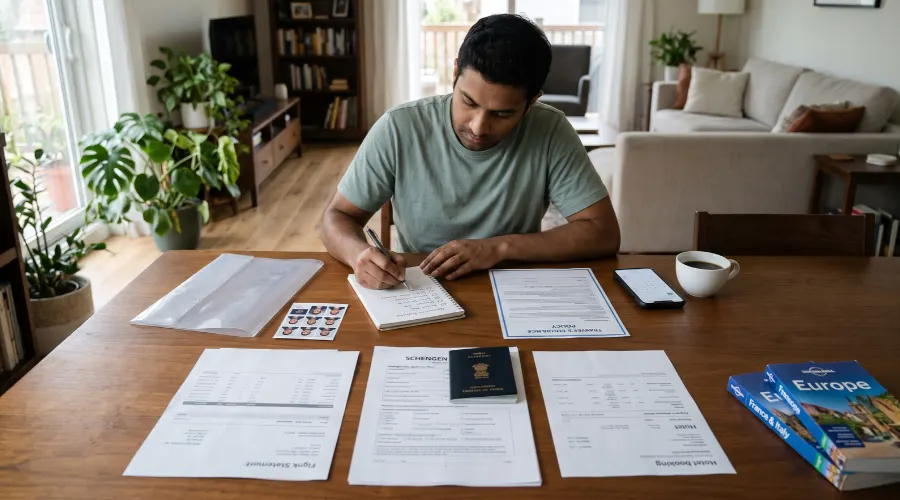
Every Indian applicant needs these, whatever the purpose of travel. Always carry the original and a photocopy of each.
| Document | What You Need to Know |
| Visa application form | Filled online, printed and signed. Every detail must match your passport. |
| Valid passport | Issued within the last 10 years. Valid for at least 3 months after you leave the Schengen area. Needs at least 2 blank pages. |
| Passport photos | 35 x 45 mm, white background, taken in the last 6 months, face clearly visible. |
| Old passports | Carry them if they hold earlier Schengen or other visas. They show your travel history. |
| Travel insurance | Must cover all Schengen countries for your whole stay, with at least €30,000 medical cover. |
| Flight reservation | Confirmed round-trip booking or itinerary showing entry and exit. |
| Accommodation proof | Hotel bookings or an invitation letter with the host’s address. |
| Cover letter | A short letter explaining your trip purpose, dates and plans. |
| Proof of funds | Bank statements and income proof. Details are in the next section. |
| Visa fee payment | Paid at the time of your appointment. |
A few points here deserve more detail.
- Passport check: Some embassies reject passports with damaged pages or remarks on the data page. Check yours before booking anything.
- Photos: Many application centers now take a digital photo at your appointment. Ask first, so you do not waste money on prints.
- Insurance: Some missions, such as Germany, accept policies only from approved Indian insurers. Check your embassy’s list before buying.
Financial Documents: Proving You Can Afford the Trip
Embassies want to see that you can pay for your stay and that you will return to India. The papers depend on your profession.
| Your Profile | Documents to Submit |
| Salaried employee | Last 3 months’ salary slips, last 6 months’ bank statements, Income Tax Returns (ITR) or Form 16 for the last 2 years, employment letter, and a leave approval letter. |
| Self-employed or business owner | Business registration proof, GST registration, 2 years of ITR, 6 months’ business and personal bank statements, and a company letter. |
| Student | Bonafide certificate from school or college, a No Objection Certificate (NOC), and the parents’ bank statements and ITR if they are funding you. |
| Retired person | Pension statements for the last 3 months, 6 months’ bank statements, and any property or investment proof. |
| Homemaker | Spouse’s income proof, bank statements, marriage certificate, and a sponsorship letter from the spouse. |
Here are some tips on bank statements:
- Get them stamped and signed by the bank. Passbook copies are usually not accepted.
- Avoid large, unexplained deposits just before applying. They look suspicious.
- Keep a healthy, steady balance. No single amount is fixed for every country, so check your embassy’s guidance.
Travel Documents: Flights, Hotels and Itinerary
Your plan should look real and sensible.
- Flights: A round-trip reservation is enough. Do not pay for a non-refundable ticket before you get the visa.
- Hotels: Book with free cancellation. Dates must match your flight dates.
- Itinerary: A day-by-day plan showing cities and dates. It does not need to be fancy, but it must be consistent.
- Multi-country trips: Show how you will travel between countries, such as trains or short flights.
Make sure your cover letter, flights, and hotel bookings all tell the same story. Mismatched dates are a red flag.
Extra Documents for Special Cases
Some situations need additional paperwork.

Visiting Family or Friends
- Invitation or sponsor letter from your host
- Copy of the host’s passport and residence permit
- Host’s proof of address in Europe
- Proof of your relationship, such as birth or marriage certificates
- Host’s bank statements for the last 3 months, if they are paying for your trip
Business Travel
- Invitation letter from the European company
- Letter from your employer stating the purpose and duration of your trip
- Company registration papers and recent bank statements
- Details of meetings, conferences or trade fairs
Study, Research or Short Courses
- Admission or enrolment letter from the institute
- Proof of course dates and fees
- Proof of accommodation
- Parents’ financial documents, if they are your sponsors
Children Under 18
- Birth certificate
- Application form signed by both parents
- Copies of both parents’ passports
- Parents’ visa copy, if one parent is traveling separately
- Consent letter from the parent who is not traveling
Visa Fees in 2026
Fees are the same for single-entry and multiple-entry visas.
| Applicant | Visa Fee (Euro) | Approx. Fee in India* |
| Adults | €90 | Around ₹9,790 |
| Children aged 6 to 11 | €45 | Around ₹4,890 |
| Children under 6 | Free | Free |
The rupee amount follows consular listings from April 2026 and changes with the exchange rate. You will also pay a service fee to the application center, plus the cost of travel insurance. Together, expect the total cost to be a few thousand rupees above the visa fee.
When Should You Apply?
- Earliest: Up to 6 months before your travel date.
- Latest: At least 15 days before you travel.
- Best time: Apply 6 to 8 weeks before departure, especially for peak seasons like summer and December.
Processing normally takes about 15 calendar days. It can stretch up to 45 days if the embassy needs extra checks. Appointment wait times are separate, and they can be long in busy months. So book your slot early.
Biometrics: What to Expect at the Appointment
You have to visit the application center in person for your first application. Children must attend too. Officers will:
- Check your documents
- Take your fingerprints and photo
- Collect your fee
Fingerprints stay valid for 59 months, so you may not need to repeat them for a later application. Keep your receipt and tracking number safe.
Visa Rule Updates for Indian Travelers in 2026
The latest visa rule updates matter for planning, so here is what is new.
1. The Cascade Rule for Indians
The European Commission introduced special rules for Indian nationals in 2024. If you live in India and have lawfully used two Schengen visas in the last three years, you can be eligible for a 2-year multiple-entry visa. After that, a 5-year multiple-entry visa may be possible, as long as your passport has enough validity. The visa is still not guaranteed. The embassy decides case by case, based on your travel history.
2. Entry/Exit System (EES)
The EU’s digital border system has been fully operational since 10 April 2026. It replaces passport stamps. At the border, you will have your face photo and fingerprints recorded on your first entry. Children under 12 do not give fingerprints. Indian travelers are covered by this system. There is nothing to do before traveling. Just allow extra time at the border and cooperate with the checks.
3. ETIAS Is Not for You
Many people confuse ETIAS with a visa. ETIAS is a travel authorization for people who do not need a visa. Indians still need a Schengen visa. Also, ETIAS is not yet in operation, and the EU says it will announce the start date months in advance. Beware of websites that claim to sell ETIAS now.
4. India-EU Mobility Talks
Reports say India and the EU have signed a mobility agreement in 2026. It may bring easier procedures for students, researchers, and frequent travelers. The timelines are still being worked out. Until your embassy announces changes, follow the current checklist.
5. Fee and Digital Changes
The EU has also talked about more digital applications and possible fee changes. Nothing for Indians has changed beyond the €90 fee at the time of writing. Always check your embassy’s official page before paying.
Common Mistakes That Lead to Rejection
Avoid these, and your chances improve a lot.
- Submitting incomplete or unsigned forms
- Showing weak or unexplained finances
- Providing fake bookings or forged documents (this can lead to a ban)
- Choosing the wrong embassy
- Poor travel history with unclear travel purpose
- Insurance that does not meet the requirements
- Not showing strong ties to India, such as a job, business, family, or property
Final Thoughts
A clean file wins visa approvals. If your Schengen visa documents are complete, consistent, and honest, you give the officer very little reason to say no. Start early, double-check every page, and keep an eye on visa rule updates before you apply. A little preparation now means a smooth, happy trip to Europe later.
FAQs
1. How many documents do I need for a Schengen visa from India?
A. There is no fixed number. The core list has about 10 items, and extra papers depend on your profession and travel purpose. Always follow the checklist of the specific embassy you apply to, because each country can ask for small extras.
2. Is a confirmed flight ticket compulsory?
A. Not usually. A flight reservation or itinerary showing your entry and exit dates is normally accepted. It is wise to avoid paying for non-refundable tickets until you have the visa in your hands.
3. Can I apply for a Schengen visa if I am self-employed?
A. Yes. Submit your business registration, GST details, 2 years of ITRs, and 6 months of bank statements. A clear business profile and steady income show that you will return to India.
4. How much bank balance is needed?
A. There is no single amount for all countries. Each country sets its own daily requirement. Look at your embassy’s guidelines and keep a steady, genuine balance that comfortably covers your trip.
5. What if my Schengen visa is rejected?
A. You will get a written reason. You can appeal within the time given in the letter, or fix the problem and apply again. Do not rush to reapply with the same documents, because the same result is likely.