You reach the airport early, bag packed and ready. At the gate, the staff member looks at your bag and points to the sizer. Your bag does not fit. Now you must pay extra fees or leave some items behind. This happens to travelers every day.
Carry-on size limits change from one airline to another. A bag that works on one flight may not work on the next. Some airlines also check the weight, not just the size.
In this guide, you will learn the common size limits, how to measure your bag, and how to avoid extra fees. Read on, and pack smart before your next trip.
Typical Carry-On Size Limits
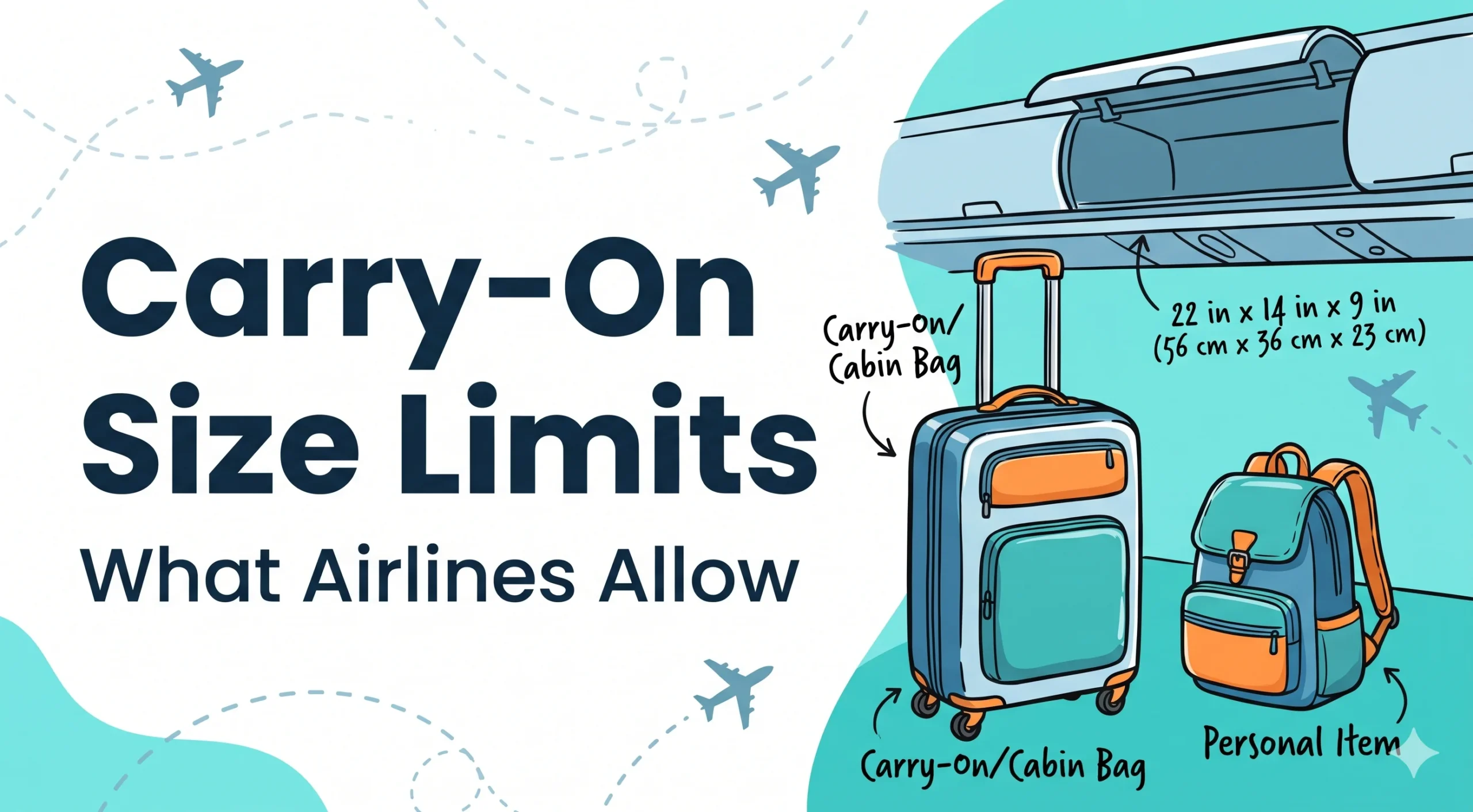
There is no single rule for cabin baggage size. Each airline sets its own limits, so airline baggage rules can differ even on the same route. Most carriers allow a bag of about 55 cm x 35-40 cm x 20-25 cm, and many cap the weight at 7 to 8 kg. Always measure your bag with its wheels, handles, and outer pockets included.
| Airline | Max Cabin Bag Size | Weight Limit | Notes |
| IndiGo | 55 × 35 × 25 cm | 7 kg | Allows 1 small personal item up to 3 kg. |
| Air India (Economy) | 55 × 40 × 20 cm | 7 kg (domestic) / 8 kg (select intl.) | Allows 1 additional small personal item. |
| Emirates (Economy) | 55 × 38 × 22 cm | 7 kg | Standard 1-piece carry-on allowance. |
| Qatar Airways (Economy) | 50 × 37 × 25 cm | 7 kg | Standard 1-piece carry-on allowance. |
| Delta / American / United | 56 × 36 × 23 cm (22 × 14 × 9 in) | No weight limit | Must be able to lift into bin unassisted (United Basic Economy excludes free overhead bag). |
| Lufthansa | 55 × 40 × 23 cm | 8 kg | Plus 1 personal item (up to 40 × 30 × 10 cm). |
| British Airways | 56 × 45 × 25 cm | 23 kg (51 lbs) | Uniform across all fare classes (including Basic). |
| Ryanair (Free Bag) | 40 × 30 × 20 cm | No official limit | Must fit completely under the seat in front. |
| easyJet (Free Bag) | 45 × 36 × 20 cm | Up to 15 kg | Must fit under seat; overhead bag requires paid option. |
Personal Item vs Carry-On: What’s the Difference?
Many travelers mix up these two bags. A personal item is a small bag that fits under the seat in front of you. A carry-on is a bigger bag that goes in the overhead bin.
| Feature | Personal Item | Carry-On Bag |
| Where it goes | Under the seat in front of you | Overhead bin |
| Typical size | About 18 x 14 x 8 in on American and Delta, 17 x 10 x 9 in on United | About 22 x 14 x 9 in on major US airlines |
| Examples | Backpack, handbag, laptop bag | Small rolling suitcase, duffel bag |
| Cost | Usually free on every fare | Free on most fares, but some budget and basic fares charge extra |
| Weight limit | Often none, or counted with your carry-on | Often 7 to 8 kg on Indian and Gulf airlines |
| Best for | Phone, wallet, laptop, documents, snacks | Clothes, shoes, and other trip items |
Carry-On Size Limits for Budget Airlines
Budget airlines make money from extras, and bags are a big one. Most give you one small free bag that fits under the seat. A bigger bag costs extra, and staff at the gate do measure. Here are the limits as of November 2026:
| Airline | Free bag | Bigger bag (paid) |
| Ryanair | 40 × 30 × 20 cm | 55 × 40 × 20 cm, 10 kg (Priority) |
| easyJet | 45 × 36 × 20 cm | 56 × 45 × 25 cm (large cabin bag add-on) |
| Wizz Air | 40 × 30 × 20 cm, 10 kg | 55 × 40 × 23 cm, 10 kg (WIZZ Priority) |
| IndiGo | 55 × 35 × 25 cm, 7 kg, plus a 3 kg personal item | Not needed |
India works differently. IndiGo lets you carry a full-size cabin bag for free, while European budget airlines do not.
Measure your bag at home, and count the wheels and handles. If it’s too big, the airline can send it to the hold and charge you. Wizz Air’s gate fee, for example, is about €65. Rules change often, so check your airline’s website before you fly.
How Strict Are Airlines About Carry-On Size?
Very strict. Budget airlines treat carry-on size limits as a hard rule and their staff check bags often.
Here is how each airline handles it:
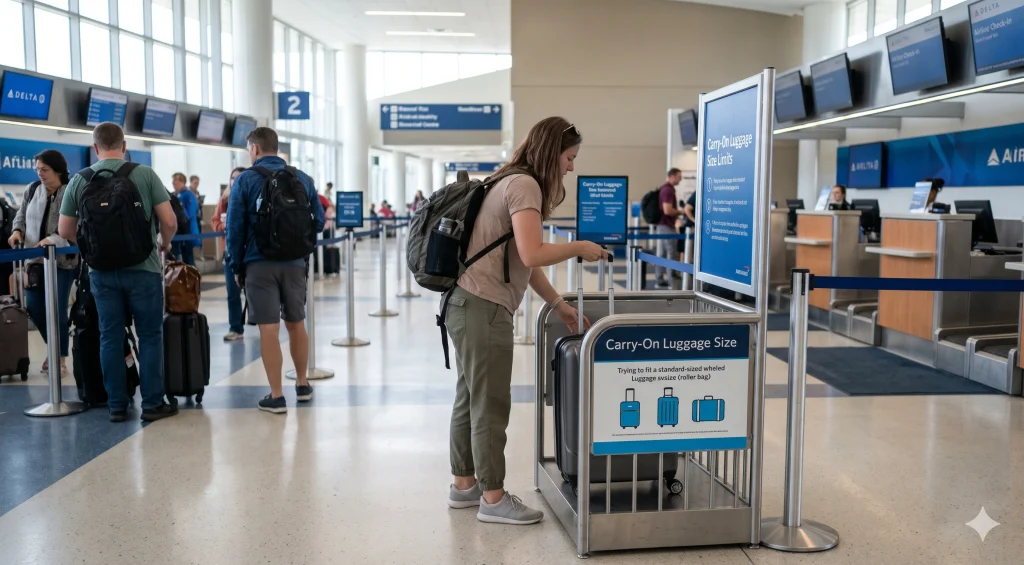
- Ryanair: Gate staff put bags into a metal sizer. If your bag does not fit it does not board with you.
- Wizz Air: Sizers stand near the check-in desks and the boarding gates. You can test your bag before you join the queue.
- easyJet: Ground staff measure bags regularly. Busy airports see the most checks.
- IndiGo: Staff tag your cabin bag at security. They also watch the 7 kg weight limit closely.
Why do airlines care so much? Every bag in the cabin takes up space. Overhead lockers fill up fast and slow boarding can delay a whole flight. Bag fees also bring in extra money for budget airlines.
Some people hope a bag that is only slightly too big will slip through. That is a risky bet. The sizer does not care about one extra centimetre. Wheels and handles count too. A soft bag has a better chance than a hard case because it squeezes into the frame.
The safest plan is simple. Check the cabin baggage size for your airline before you pack. Then measure your bag at home. Airline baggage rules look small on paper but gate staff follow them to the centimetre.
What Happens If Your Carry-On Bag Is Too Big?
You pay a fee and your bag goes into the hold. That is the usual result. It happens at the gate and it costs more than most people expect.
Here is what to expect:
- A gate fee: Wizz Air charges about €65 (£48) for an oversized bag. Ryanair charges around €46 if you bring a large bag without Priority.
- Hold luggage: Staff tag your bag and load it under the plane. You collect it at the baggage belt after landing.
- Lost time: You wait at the belt while other passengers walk out. This hurts if you have a tight connection.
- A risk to your things: Your laptop or medicine can get lost or damaged if it stays inside the bag.
What You May Want to Know?
Paying online is far cheaper. Kayak notes that gate fees cost much more than adding a bigger bag when you book. So decide before you fly and not at the gate.
Here is how to avoid the fee:
- Check the carry-on size limits before you book.
- Measure your bag with its wheels and handles.
- Wear your heaviest clothes on the plane.
- Add the right bag online if you need more space.
- Keep your valuables in a small bag in case staff send your main bag to the hold.
Conclusion
Carry-on size limits look small on paper but airlines enforce them to the centimetre. Every airline sets its own cabin baggage size, so a bag that works on one flight can fail on the next. Check the airline baggage rules before you pack and measure your bag with its wheels and handles. Pay for a bigger bag online if you need one because gate fees cost far more. A few minutes of prep saves you money and stress at the airport.
FAQs
Can we carry 2 bags for 30 kg in IndiGo?
Not in the cabin. IndiGo allows one 7 kg cabin bag plus a 3 kg personal item. A 30 kg total only works with checked baggage, so pre-book the extra weight online to pay less.
Can I carry a backpack and a carry-on?
Yes on most full-service airlines and on IndiGo. Your backpack goes under the seat and your carry-on goes in the overhead bin. Ryanair, Wizz Air and easyJet allow only one small free bag unless you pay for a bigger one.
Is a 22.5 inch carry-on too big?
Yes in most cases. 22.5 inches is about 57 cm and most airlines cap the length at 55 or 56 cm (22 inches). Check your airline’s limit and measure with the wheels and handles.
Which airlines are strict about carry-on size?
Budget airlines like Ryanair, Wizz Air, easyJet and IndiGo check cabin baggage size and weight the most. Staff use sizers at the gate or tag bags at security, so measure your bag before you fly.