Ever stood at the check-in counter, watching your suitcase on the scale, heart racing as the number climbs? You’re not alone. Every year, millions of travellers pay surprise fees because they skipped the fine print.
The truth is that airline baggage rules change often, and they differ from one airline to the next. Even your fare type can change what you’re allowed to carry.
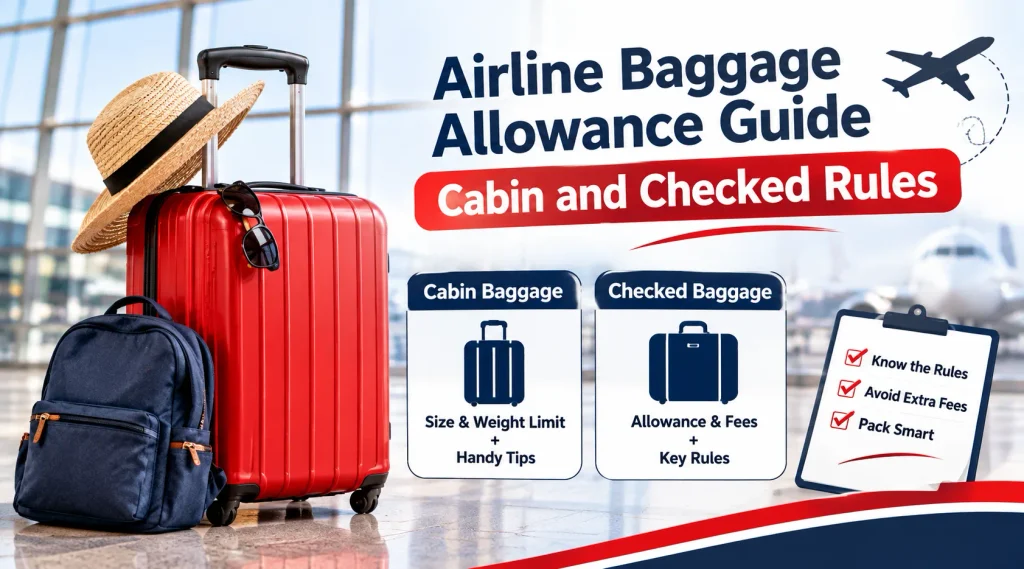
This guide explains cabin and checked baggage in simple words. You’ll learn the right cabin baggage size, weight limits, fees, and banned items, so you can pack smart and stay stress-free.
Cabin Baggage vs Checked Baggage: What’s the Difference?
Let’s start with the basics.
- Cabin baggage (also called carry-on or hand luggage) is the bag you take inside the plane with you. It sits in the overhead locker or under the seat in front of you.
- Checked baggage is the bag you hand over at the check-in counter. It travels in the aircraft’s hold, and you collect it at the baggage belt after landing.
Here’s a quick comparison:
| Feature | Cabin Baggage | Checked Baggage |
| Where it travels | With you, inside the cabin | In the cargo hold |
| Typical weight limit | About 7–12 kg | About 15–32 kg per piece |
| Fee | Usually free (with exceptions) | Often free or paid, depending on fare |
| Best for | Essentials, valuables, electronics | Clothes, shoes, bulky items |
| Risk of delay or loss | Very low | Small, but real |
What Is the Standard Cabin Baggage Size?
Here’s the honest answer: there is no single universal size. IATA gives 56 × 45 × 25 cm as a general reference for the maximum carry-on, but each airline sets its own rules. Your allowance can also depend on your fare, route, and aircraft. Always measure your bag with its wheels, handles, and side pockets included. Airlines commonly measure the full external size of the bag. That’s why a bag that looks small on paper sometimes fails the sizer at the gate.
Here are some popular examples:
| Airline | Cabin Bag Size (cm) | Weight Limit |
| Ryanair (small bag) | 40 × 30 × 20 | Not specified |
| Ryanair (Priority overhead bag) | 55 × 40 × 20 | Check airline |
| Lufthansa (Economy Classic+) | 55 × 40 × 23 | 8 kg |
| Air France / KLM | 55 × 35 × 25 | 12 kg |
| easyJet (Plus fare) | 56 × 45 × 25 | 15 kg |
| IndiGo | 55 × 35 × 25 | 7 kg |
These figures change, so confirm them on your airline’s website before you fly.
Cabin Baggage Weight and the Personal Item
Size is only half the story. Weight matters just as much, and it’s where many travellers get caught. Cabin weight limits are generally between 10 and 12 kg, but budget and domestic carriers are often stricter. In India, for example, 7 kg is the common limit for economy. Many airlines also let you carry one small personal item. Think of a laptop bag, handbag, or small backpack that fits under the seat. IndiGo, for instance, allows a 7 kg cabin bag plus a personal item under 3 kg.
A few tips to remember:
- Your laptop counts toward your weight limit, whether it sits in your main bag or your personal item.
- Budget fares often allow only a small underseat bag. Larger bags cost extra.
- United is the only major US carrier that doesn’t include a free carry-on on Basic Economy. It charges a $25 gate handling fee if you bring one.
Checked Baggage Allowance: Weight vs Piece System
Airlines use two systems for checked bags.
- Weight system: You get a fixed number of kilos (say, 15 kg or 20 kg), and you can split it as you like. This is common in India, Asia, and the Middle East.
- Piece system: You get a set number of bags (like one or two), and each bag has its own weight limit. This is common on flights to and from the Americas.
Most airlines cap a single checked bag at 23 kg in economy, while premium cabins often allow 32 kg. On Air India Express, no single piece may exceed 32 kg or 158 cm (length + width + height) on any route. Many other airlines follow the same rule of thumb. Your fare type changes everything. A “Saver” or “Basic” fare may have no checked bag at all, while a “Flex” fare may include a lot.
Airline Baggage Allowance Guide for Indian Airlines
If you fly within India, these numbers are worth knowing. Rules differ by fare, so treat this as a guide and check your booking.
| Airline | Cabin Bag | Personal Item | Domestic Checked Bag |
| IndiGo | 7 kg, 55 × 35 × 25 cm | Up to 3 kg | 15 kg on standard fares |
| Air India | 7–8 kg (varies by fare) | 1 item, up to 3 kg | 15 kg (Value), 20 kg (Classic), 25 kg (Flex) |
| Air India Express | 7 kg, 55 × 35 × 25 cm | Up to 3 kg | 0 kg (Lite), 15 kg (Value/Classic), 20 kg (Flexo) |
| SpiceJet | 7 kg | Counted within 7 kg | 15 kg |
There’s one new thing worth knowing. IndiGo has launched a “Lite” fare for travellers carrying only cabin luggage, and Air India Express already offers cabin-only fares. These fares are cheaper, but you can’t check a bag for free. Also, pre-booking excess baggage online is almost always cheaper than paying at the airport. Airport rates can run to several hundred rupees per kilo.
Checked Bag Fees on US Airlines
US airlines usually charge for the first checked bag on domestic economy tickets. Fees rose sharply in 2026, and they keep changing.
| Airline | First Bag (approx.) | Second Bag (approx.) |
| Southwest | 35–45 | 45–55 |
| American | 35–50 | 45–60 |
| Delta | $45 | $55 |
| United | 45–50 | 55–60 |
United and Delta both raised fees in April 2026, and a third bag now costs $200 at both. Many airlines, including American Airlines and United, include a free checked bag on transatlantic and transpacific routes, though Basic Economy may still pay. Want to save money? Pay online at least 24 hours before departure, since many airlines discount advance payment. Airline credit cards and elite status also often waive the first bag fee.
Items You Can’t Carry (And Items That Need Care)
Rules about what goes inside your bag matter just as much as the size of the bag. Here’s a simple breakdown.
1. Liquids in cabin bags:
- Containers above 100 ml must go in checked baggage, not the cabin.
- Keep small bottles together in one clear, resealable bag.
2. Sharp objects: Scissors, knives, and razors with blades belong in checked bags only.
3. Lithium batteries and power banks: This is the biggest change in recent times.
- Power banks go in cabin baggage only. Never put them in checked luggage.
- Up to 100Wh is allowed without approval, and 100–160Wh needs airline approval. Anything above 160Wh is banned.
- ICAO tightened global rules from 27 March 2026, including a limit of two power banks per passenger.
- Lufthansa Group airlines have banned using or charging power banks on board since 15 January 2026. Emirates also bans in-flight use and allows one power bank under 100Wh.
Not sure about your power bank? Multiply mAh by voltage (usually 3.7V) and divide by 1,000 to get Wh. A 20,000 mAh power bank is about 74Wh, which is fine.
Smart Packing Tips From Real Travellers
A few habits will save you money and stress:
- Weigh your bag at home: A cheap luggage scale pays for itself quickly.
- Wear your heaviest items: Jackets, boots, and hoodies don’t count while they’re on your body.
- Pack valuables in the cabin: Keep your passport, medicines, chargers, and jewellery with you.
- Pack one change of clothes in your cabin bag: If your checked bag gets delayed, you’ll thank yourself.
- Take a photo of your bag: It makes lost-luggage claims much easier.
- Buy a soft-sided cabin bag: It squeezes into tight sizers more easily than a hard shell.
Common Mistakes That Cost Money
Even experienced travellers slip up. Watch out for these:
- Reading only the cabin class and ignoring the fare type.
- Forgetting that connecting flights on different airlines can have different limits. Check every airline on your itinerary.
- Measuring the bag without wheels and handles.
- Packing a power bank in checked luggage.
- Trusting an old blog post. Rules change, so always check the airline’s own website.
Quick Pre-Flight Checklist
Before you leave for the airport, run through this:
- Confirmed my fare’s baggage allowance
- Checked the cabin baggage size and weight limit
- Weighed my bags
- Packed liquids under 100 ml in the cabin
- Put power banks in my cabin bag
- Added my name and phone number to every bag
Final Thoughts
Learning the airline baggage rules before you travel is one of the easiest ways to save money and avoid stress. Remember the key points: measure your bag fully, weigh it at home, read your fare type, and keep power banks in the cabin. Rules change often, so treat any guide, including this one, as a starting point and confirm the latest details on your airline’s official website. Safe travels, and happy packing!
FAQ
1. What is the standard cabin baggage size for airlines?
A. There’s no single standard. IATA’s general reference is 56 × 45 × 25 cm, but each airline sets its own limit. Always check your airline before you fly.
2. Can I carry a laptop bag along with my cabin bag?
A. Often yes, as a personal item. But on some airlines, especially in India, the laptop’s weight counts toward your total cabin limit.
3. Is a power bank allowed in checked baggage?
A. No. Power banks must travel in your cabin baggage only. Many airlines also ban using them during the flight.
4. How much does excess baggage cost?
A. It varies by airline and route. Paying online before your trip is usually much cheaper than paying at the airport counter.
5. Do the same baggage rules apply on connecting flights?
A. Not always. If you fly with two different airlines, the strictest rule may apply. Check every leg of your journey.